EVERYDAY MATH · CHECKED TEMPLATES
Math word problem generator Read the story. Explain the relationship.
Use this math word problem generator for printable one-step and two-step practice with checked arithmetic and units. Choose operations, everyday contexts and a quantity limit, then review each story beside its worked answer. Adjustable columns, rows and writing space help the sheet fit your lesson.
Checked structure · Adjustable grid · A4 / Letter
Math word problem generator
Choose the content, generate a set and review both copies.
My worksheets
Drafts save automatically in this browser, including unfinished input. Keep up to 20 named worksheets across all tools. Large images may exceed browser storage; download data as a backup.
Worksheet preview
Fit complete rows onto each page using the selected columns and writing space. Extra page space stays at the bottom; answer gaps are not stretched.
Request 1–6 questions across and 1–12 rows. Longer prompts or worked references can reduce the actual grid.
Generate to review the content and matching reference.
Match A4 or Letter in the browser print dialog. Choose Save as PDF and review every student and answer page; switch off browser headers and footers if needed.
A story gives the numbers a relationship
Make room for understanding the situation and showing a method.
Practise the structure behind the calculation
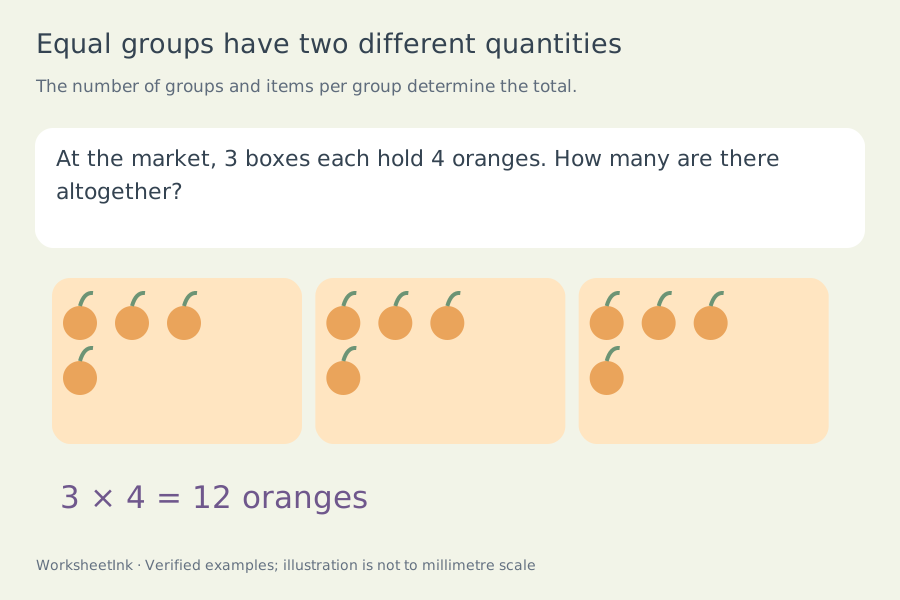
Useful word problem worksheets connect quantities to a question. A number of boxes and the amount in each box describe equal groups; a total shared among boxes describes division. The same arithmetic can sit inside several everyday settings without becoming a different learning objective. These math story problems use reviewed, explicit templates so the story conditions agree with the calculations. Select the operations and step level deliberately. The maker does not label a set as universally suitable for a grade, diagnose a reading need or replace a teacher's judgment about whether the language is accessible.
Show what each result means
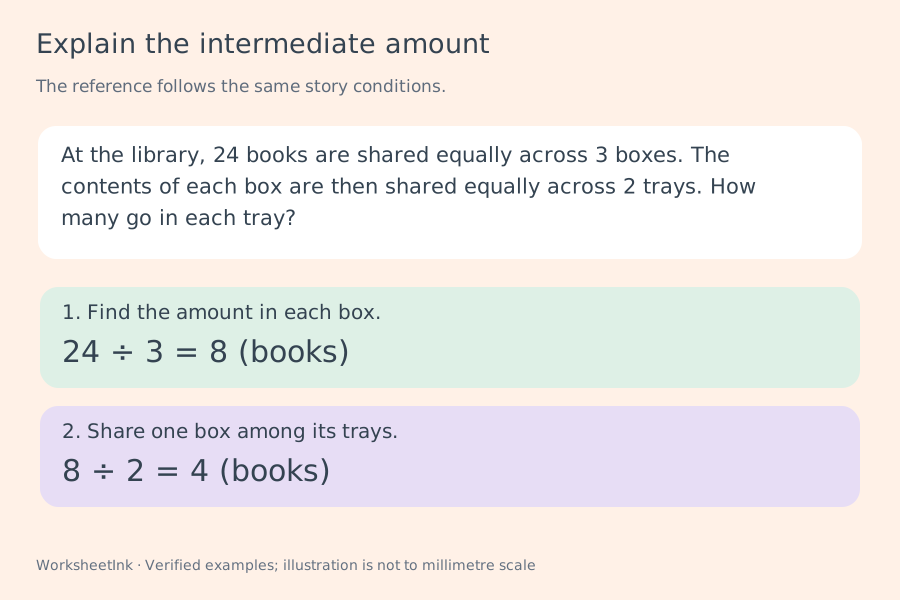
A final number alone can hide a misunderstanding. The reference explains the intermediate result, gives a calculation and labels its unit before continuing. In nested groups, the first answer may be boxes rather than books; in two rounds of sharing, each result refers to a different container level. The student paper leaves ruled space for a diagram, expression or short explanation. Review the key with your class as one consistent route to the result, while accepting other mathematically valid approaches when they match the original conditions. No automatic online marking is performed.
Build a set around the relationship you want learners to explain
Select the structure, check the quantities and reserve useful working room.
- 01
Choose a mathematical relationship to practise
Decide whether the lesson concerns combining amounts, taking an amount away, equal groups or sharing equally. Select only the operations your learners are ready to use. One-step practice keeps one calculation per story; two-step practice adds another necessary calculation. Mixed mode can include both.
The template set is deliberately explicit. It contains joining, removing, multiplying equal groups and equal sharing; two-step variants join three amounts, remove twice, count nested groups or share twice. When the necessary operations are selected, it can also combine multiplication with addition or subtraction. These are particular problem structures, not a complete catalogue of elementary word-problem types.
- 02
Keep quantities within a meaningful limit
Set the maximum quantity between six and 100. Every stated number, intermediate result and final answer must remain within that limit. This is useful when reading the relationship is the goal and large arithmetic would distract from it. Raising the limit allows more combinations without changing the underlying structure.
All quantities are positive whole numbers. Subtraction leaves at least one object, and sharing always divides exactly. For multiplication and division, the tool constructs or checks the relevant product rather than treating two small factors as permission for an unlimited total. Very narrow settings can yield fewer available examples. Check notices and the actual generated count instead of assuming the requested number was always possible.
- 03
Use the context to make units explicit
Choose the library, garden or market, individually or together. Their objects are books, seedlings and oranges. The wording is authored for the selected language and uses those units consistently. The setting gives a familiar situation, but does not alter the mathematical relationship or attach a verified grade level to the question.
Read a sample story aloud before assigning a set. Ask learners what is known, what is being asked and which quantities refer to groups rather than objects. In a shelf-and-box problem, a count of boxes is different from a count of books. The teacher reference preserves that distinction in its intermediate units. Avoid teaching operation selection solely from one cue word in a sentence.
- 04
Look for a reason behind each calculation
Generate a manageable set and compare the student questions with the reference. Each answer includes the exact story, one or two calculations, brief explanations and a final quantity. In a two-stage sharing problem, the first division finds the contents of one box; the next division shares that amount among the trays in that box.
Invite learners to draw groups, label a diagram or explain why their expression matches the situation. A correct alternative combined expression may be shorter than the two displayed steps. The reference illustrates a consistent method; it is not an automated rule that rejects every other strategy. The page neither collects students' work nor decides how much credit a partially correct explanation deserves.
- 05
Change one example without losing its consistency
Use the item editor when a chosen example needs different numbers or a different eligible structure. The parameter help explains what a, b and the third parameter mean for that specific template. One-step structures use only the first two parameters. Changing a template can therefore change their interpretation.
Every accepted edit rebuilds the wording, calculations and final answer together. It must still satisfy the current operation selection, contexts, quantity bound and integer rules. An exact repeat of another question is rejected. The revision identifier changes so that saved keys can be matched to the edited sheet. Free-form rewriting is not supported here, because the automatic answer could otherwise become detached from the new story.
- 06
Use the page deliberately, then keep the data
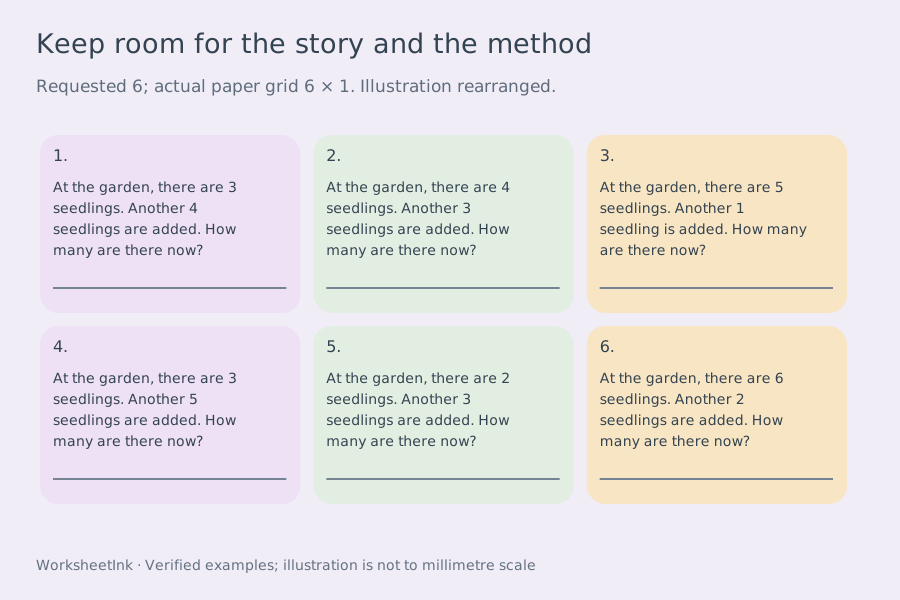
Request one to six questions across and one to twelve rows. Choose compact, normal or extra space, which adds zero, eight or sixteen millimetres after the standard writing lines. A short one-step story can fit more closely than a two-step problem with a worked explanation. The capacity display reports the actual grid after checking both outputs.
The planner reduces columns or rows when necessary instead of reducing text size. Adjusting density keeps the same questions and version; changing content settings requires generation. Choose A4 or Letter, match it in the browser dialog and inspect every page. Save JSON for the exact set and manual revisions, and use browser saving for convenience on the same device. Neither option is a cloud classroom record.
Questions before you print
Practical details about input, answers and page space.
Select addition, subtraction, multiplication and division independently, then choose one-step, two-step or mixed practice. The maker uses a defined set of reviewed structures. Two-step sets include repeated operations; multiply-then-add and multiply-then-subtract structures also appear when both required operations are enabled. Selection rotates across eligible structures, but a short request need not include every one. The displayed questions are the authoritative set.
No. Numbers and three everyday contexts vary inside explicit templates. The library uses books, the garden uses seedlings and the market uses oranges. This bounded design keeps conditions, arithmetic and units connected. You can change template parameters in the item editor, within the current rules. There is no free-form topic prompt, textbook upload or claim of alignment to a particular curriculum or grade.
Yes. One-step problems require one listed calculation. Two-step problems show two calculations in the reference, with a short explanation of each. For nested equal groups, the first result counts boxes and the second counts objects; for repeated sharing, the first result is per box and the second per tray. A learner may use a mathematically equivalent combined expression, which you can assess yourself.
This tool deliberately uses exact whole-number sharing. It constructs divisible totals, uses positive divisors and excludes remainder cases. Subtraction leaves a positive amount. That keeps the current stories unambiguous: each container receives the same complete number of objects. For long-division methods or remainder practice, use the separate column-calculation tool. There is no rounding control or decimal-money scenario on this page.
Choose an integer from six to 100. The limit applies to every stated and calculated quantity in the current templates, including products, dividends and intermediate totals. It does not mean that every problem uses the maximum. Tight limits leave fewer combinations, especially for two-step multiplication and division. The maker reports shortages or unavailable structures rather than printing a question outside the selected bound.
Yes. Every reference repeats the exact student story and lists its calculation steps, explanations, units and final quantity. Units follow the chosen context, and intermediate box totals are labeled as boxes. The student copy has visible writing lines without the generated calculations or final answer. The website does not read what students write, choose partial credit or collect class scores.
Request one to six problems across and one to twelve rows, then select compact, normal or extra space. A story and its worked reference take more room than a short equation, so the actual grid may be smaller. Both outputs are included in the capacity estimate. Keep room for a diagram or equation when that is part of your lesson, and inspect the complete print preview.
Yes. Change a numbered item's supported template, context or positive parameters, then save the resulting revision. The editor recomputes wording and answers together and rejects duplicate or out-of-range questions. Download JSON to preserve the actual questions, seed, settings and edits. Import validates the derived story and calculations. Density changes rearrange that same version; generating again replaces the selected set after the app's existing confirmation.
Prepare the next useful practice sheet
Review the content and give learners room to show their thinking.
Browser printing & PDF · No registration