NOTICE · CONTINUE · EXPLAIN
Pattern worksheet generator Find the change. Tell the story.
Prepare number patterns worksheets and repeating shape activities around a rule you choose. This pattern worksheet generator creates missing items, keeps the intended rule with every answer and lets you control how much help appears on student pages. Use a few short sequences for a warm-up, or build a longer set with room for learners to explain their thinking.
Numbers & shapes · Explained answers · Flexible printing
Pattern worksheet generator
Choose a rule family, arrange the missing terms and keep an explained answer copy.
My worksheets
Drafts save automatically in this browser, including unfinished input. Keep up to 20 named worksheets across all tools. Large images may exceed browser storage; download data as a backup.
Worksheet preview
Fit complete rows onto each page using the selected columns and writing space. Extra page space stays at the bottom; answer gaps are not stretched.
Request 1–6 questions across and 1–12 rows. Actual capacity depends on text length, references and writing space.
Generate sequences to see the missing terms and matching rule explanations.
Match A4 or Letter in the browser print dialog. Choose Save as PDF and review every student and answer page; switch off browser headers and footers if needed.
Give every sequence a clear starting idea
Choose a number operation or a repeating unit, then build the practice around it.
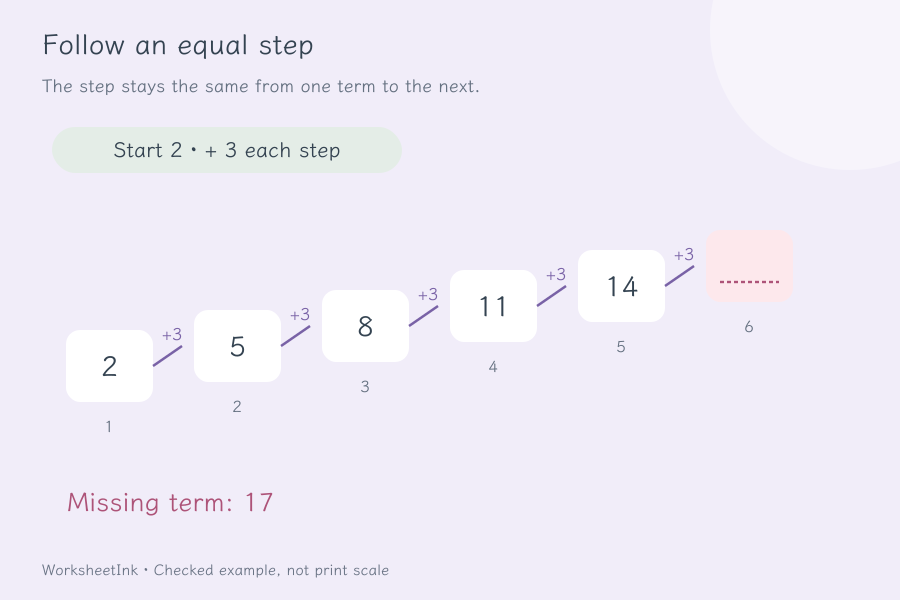
Number rules you can describe in a sentence
Choose a fixed addition, subtraction or multiplication rule. Each item has a starting value and one step or factor that applies throughout the sequence. Set ranges to vary those values across a batch, while keeping the selected operation consistent. The reference restores every missing term and explains how the sequence was built. A learner can then check a proposed answer against all the visible terms. These sequence worksheets focus on the supported rules; they do not attempt to discover every possible rule behind an arbitrary list.
Repeating patterns that work without colour
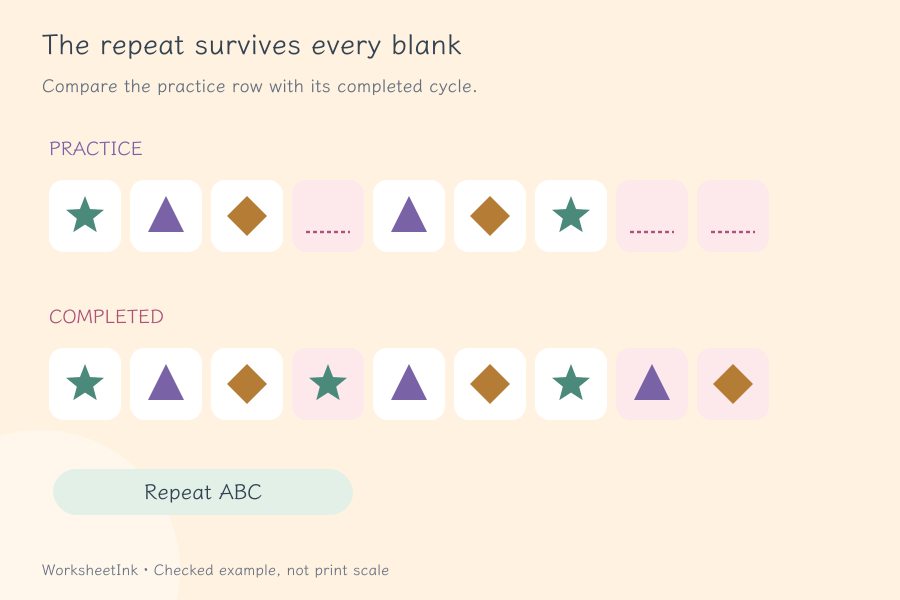
Choose AB, AAB, ABB, ABC or AABB. The letters name positions in a repeating unit, and each different letter receives a different shape. For example, AAB can mean circle, circle, triangle, repeated in that order. The shape collection includes circles, squares, triangles, stars, diamonds and hexagons. Learners can follow the structure from the outlines, so colour is not the only clue. Use the explanation to name the whole unit rather than reading one long list of shapes without grouping them.
Choose what learners should notice
A useful worksheet balances a clear rule, enough visible evidence and comfortable writing space.
- 01
Select one rule family for the set
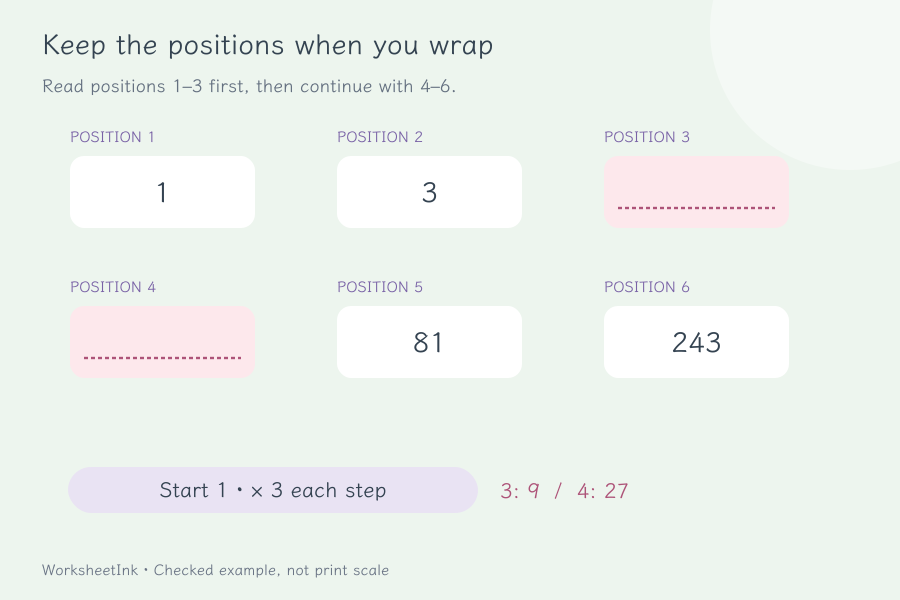
Start with addition, subtraction, multiplication or shapes. For number practice, choose starting values between −1,000 and 1,000. Addition and subtraction steps range from one to 100; multiplication factors range from two to five. Each generated item uses a fixed value within your chosen range rather than changing the step halfway through.
Subtraction can continue below zero, and a negative starting value remains negative when multiplied by a positive factor. Review those possibilities before preparing work for learners who have only met positive numbers. Every term stays within one million in magnitude. Settings that would exceed this limit reduce the available choices, so shorten the sequence or lower the values when necessary.
- 02
Give a repeating unit enough space to appear
In shape mode, choose the unit first. AB alternates two shapes; AAB and ABB repeat one of two shapes within a three-position unit; ABC uses three different shapes; AABB repeats two shapes in pairs. The same letter keeps the same shape within an item.
Choose six to twelve terms for either mode. A longer display can reveal several copies of a shape unit and make its structure easier to discuss. Twelve positions can show three complete AABB units, for example. Ask learners to bracket the group that repeats, describe its order and use that group to check a missing item. Do not rely on the last visible shape alone.
- 03
Choose the missing positions and the support level
Hide one to three terms. End placement removes the final positions, asking learners to continue the sequence. Scattered placement keeps the first term visible and chooses missing positions from the remaining terms; those positions can include the end. The gaps are part of the generated item and remain connected to its stored answers.
The optional student rule display is substantial help: it reveals the starting value and operation amount, or the shape unit and its correspondence. Use it for applying a stated rule. Leave it off when you want learners to propose and explain a rule themselves. Teacher output always includes the intended rule, so the level of support can change without replacing the underlying sequence.
- 04
Generate a varied set and review each item
Request one to 24 patterns. The tool selects from the valid choices under your settings and removes repeated complete sequences within the set. A narrow starting range or a fixed step may leave fewer distinct items than requested. The actual count and a notice make that shortage visible.
Multiplication beginning at zero gives a row of zeros regardless of the factor, so those equivalent sequences count only once. A version seed lets you reproduce the set. To replace one item, change its local seed in the editor; the replacement follows the current mode, ranges, length and missing-position settings. It updates that item’s sequence, gaps and answer together, while the other items stay in place.
- 05
Use the answer as an explanation, not a guessing verdict
A finite list of visible terms can fit more than one rule. The answer key records the rule used to create this item; it does not establish that every unrestricted continuation is impossible. When a learner suggests another pattern, ask them to describe it clearly and check it against the given terms.
For focused practice, state the allowed family or turn on the rule display. For discussion, compare explanations before revealing the reference. An answer that follows a different consistent rule may be useful reasoning even when it differs from the intended one. This maker generates from chosen rules; it is not a sequence-solving service, an automatic student marker or a universal test of mathematical creativity.
- 06
Arrange the paper and save the exact set
Request one to six items across and one to twelve rows, with zero, four or eight millimetres of extra space. Terms wrap into readable rows inside an item. The estimated capacity accounts for sequence length, wider numbers, explanations and writing room; it can reduce actual columns or rows instead of squeezing every term into a tiny box.
Student pages and teacher references may use different page counts. Match them by item number and content identifier, then inspect the final A4 or Letter preview before printing. Save locally for quick reuse or download the exact worksheet data for later import. Layout and rule-display changes keep the content version. Replacing an item creates a revision, so retain the corresponding updated answer copy.
Questions before the next term
Help learners explain a pattern and give yourself a clear reference.
Compare neighbouring visible terms, then test a proposed rule across the sequence rather than stopping after one match. This tool lets you choose the family in advance. The reference states the starting value and fixed step or factor. If a gap hides a neighbouring term, use the complete explanation when checking the learner’s reasoning, not just the final number.
Each letter represents a category of shape, and the whole group repeats. Different letters use different shapes. AAB might be square, square, star; ABB might be square, star, star. Ask learners to name the unit in order and find it again later in the row. The particular shapes can change between items while the selected structure remains the same.
Yes, when no rule family or other condition is specified. Seeing several matching terms is not a proof that one continuation is the only possible one. These worksheets are generated from an explicit stored rule, and the reference explains that intended construction. For a task with clear expectations, tell learners which operation or repeating unit they should apply.
Choose scattered gaps to select one to three missing positions after the first term. A selected position can be in the middle or at the end; this option does not guarantee that every gap will be internal. End placement hides the final terms instead. Both choices retain the complete sequence and numbered missing positions for the teacher reference.
It shows the complete intended rule: the starting value and amount to add, subtract or multiply by, or the repeating shape unit with its shape correspondence. It is more than a small nudge. Use it for practising how to apply instructions, and switch it off for observation and discussion. The teacher explanation remains available in either case.
Yes. The categories use distinct shapes, not colour alone, and the reference names their order. Circles, squares, triangles, stars, diamonds and hexagons remain recognisable as outlines. Check the final print size for your learners, especially with several items across. Students can draw the missing shape in its space or use the naming convention you explain before the activity.
You can request one to six across. The usable grid depends on term length, sequence wrapping, explanations and extra space, so always check the actual capacity. Shorter sequences and smaller numbers can fit more efficiently. The teacher page reserves room for answers and rules, and may therefore hold fewer items than a student page with the same requested settings.
Yes. The item editor uses a replacement seed to generate one new pattern within the current settings; it is not a freeform term editor. The new sequence, gaps and explanation are rebuilt together, and duplicate complete sequences are rejected. Save or download the revised set if you want to reuse it. Import validates the stored content before restoring the worksheet.
Make the next step worth explaining
Choose a rule, leave a gap and keep the answer connected to the reasoning.
Browser printing & PDF · No registration