YOUR PASSAGE · CHECKED QUESTION LIST
Reading comprehension worksheet generator Keep the question connected to the text
Use this reading comprehension worksheet generator with your own passage and teacher-checked questions. Keep reference answers, source excerpts and open-response guidance together, then print a clean student copy. Flexible passage placement and independently estimated grids help both outputs use the page well.
Checked content · Adjustable grid · A4 / Letter

Reading comprehension worksheet generator
Choose the content, review the result and adjust the paper.
My worksheets
Drafts save automatically in this browser, including unfinished input. Keep up to 20 named worksheets across all tools. Large images may exceed browser storage; download data as a backup.
Worksheet preview
Fit complete rows onto each page using the selected columns and writing space. Extra page space stays at the bottom; answer gaps are not stretched.
Request 1–6 across and 1–12 rows. Student and reference capacities are estimated separately, including passage placement.
Generate to review the content and matching reference.
Match A4 or Letter in the browser print dialog. Choose Save as PDF and review every student and answer page; switch off browser headers and footers if needed.
A useful reading task keeps its evidence in view
Your passage, your questions and a reference you can review.
Build from the actual words learners will read
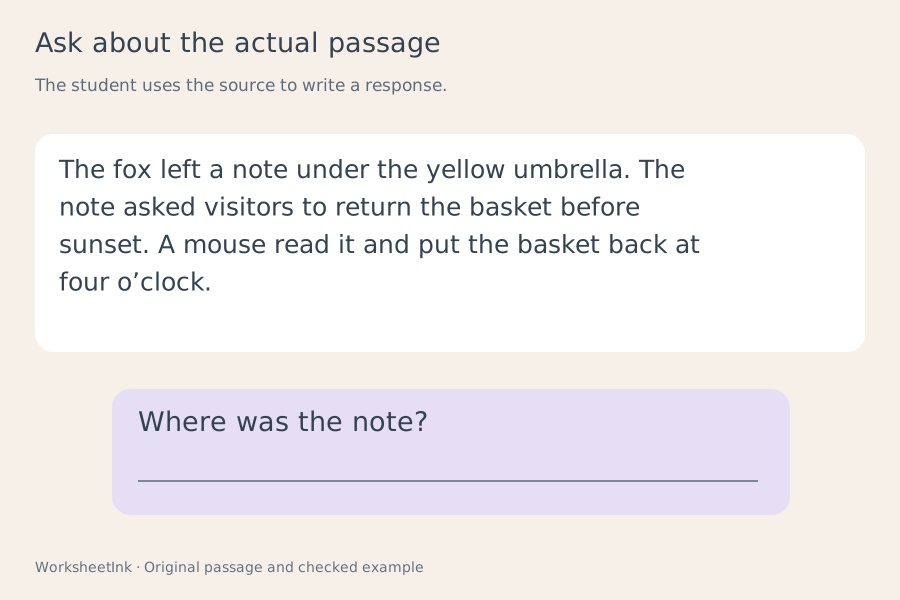
A reading worksheet maker is most useful when the questions belong to the chosen text. Paste your passage and enter the questions, references and exact excerpts that you have checked. The tool arranges those relationships into reading worksheets and reports structural problems. It does not silently replace an unclear question with an invented answer. The source text remains bound to the selected set, so changing it calls for a fresh check. Choose a focused passage and a few purposeful prompts rather than treating a longer question list as proof of deeper comprehension.
Leave room for more than one well-supported response
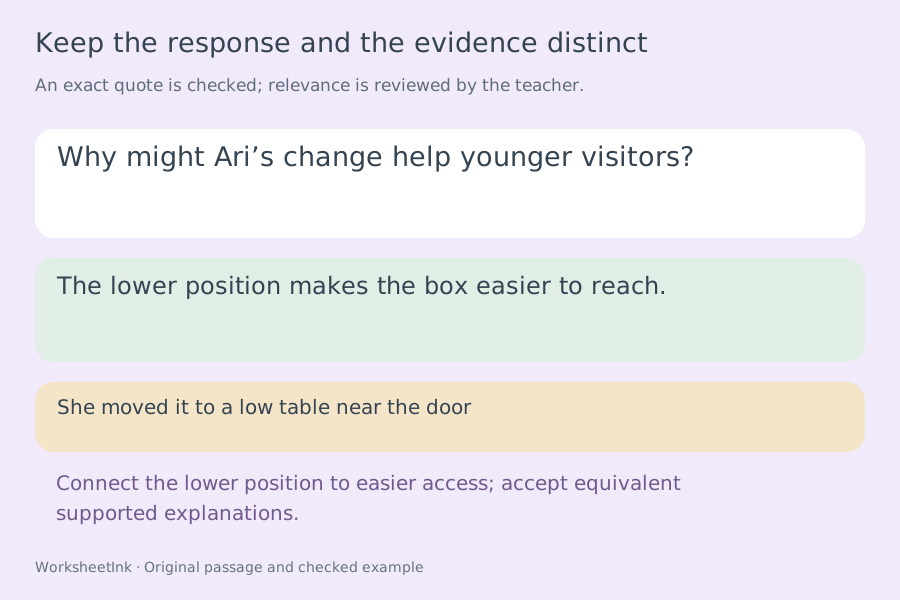
Open-ended questions can invite interpretation, explanation or a sensible next action. Provide a reference response and scoring guidance that states the connection you want learners to make. Text evidence is preserved separately so a teacher can revisit the relevant wording while marking. Finding that wording in the passage is an important consistency check, but it does not establish that an inference is sound. The student copy omits the supplied key and notes, and offers visible writing lines. You remain responsible for accepting equivalent or alternative responses that are supported by the text.
Turn a checked passage and questions into reusable practice
Review the connection, then choose where the text and writing should go.
- 01
Use a passage you can stand behind
Paste a short text you have written, checked or have permission to reuse. Give it an optional source title. The original example is available as a working starting point, not a claim of curriculum alignment. Choose language and subject matter that your learners can reasonably read before adding questions.
The normalized passage can contain up to 2,400 characters and twelve paragraphs, but it must also fit the reserved reading-page height. Blank lines separate paragraphs; whitespace inside a paragraph is simplified. An especially dense text may need shortening even below the character limit. The maker handles plain text rather than scanned pages, images, tables or a full book chapter.
- 02
Write questions with a deliberate connection to the text
Enter one question per line in the displayed format. Multiple choice uses two to six distinct options and one correct letter. Short response uses a teacher reference. Open response uses a reference plus scoring guidance. All three types require an exact source excerpt.
Do not confuse an excerpt with an answer explanation. The excerpt records the words you want the teacher to revisit; the reference explains a suitable response to the actual question. A quotation can occur in the text yet be irrelevant to the question. Review that relationship manually, and rewrite a prompt if it demands knowledge or assumptions that the passage does not supply.
- 03
Check evidence without overstating what a match proves
The tool folds whitespace and normalizes Unicode before finding the excerpt. Case remains significant. A match confirms that your quoted wording is present, including wording split over line or paragraph breaks. Each quote must contain at least three non-space characters so a single letter is not treated as meaningful evidence.
That is a structural check, not automated reading comprehension. It does not evaluate an inference, detect every misleading distractor or judge whether a character's action has one possible interpretation. For open-ended questions, explain which textual connection earns credit and accept well-supported alternatives when appropriate. The reference is a marking aid, not a system that reads students' responses.
- 04
Select and edit a manageable set
Request one to 200 questions. Keep input order to follow the passage sequence, or use a seeded shuffled selection for a different review order. A request larger than the valid list returns an honest actual count. Invalid lines, duplicates and conflicting prompts are reported rather than silently becoming extra questions.
The item editor changes a prompt, reference, excerpt, options or scoring guidance together and records a new revision. The excerpt is checked again against the same passage. Changing the passage itself is a content-setting change and requires generation, because the existing question relationships may no longer hold. Save the current data before preparing a substantially different reading task.
- 05
Let student and teacher pages use their own space
Request one through six columns and up to twelve rows. Compact, normal and extra space add zero, eight or sixteen millimetres after the standard response area. Short and open responses have three visible writing lines; choice items have a response line as well as their options.
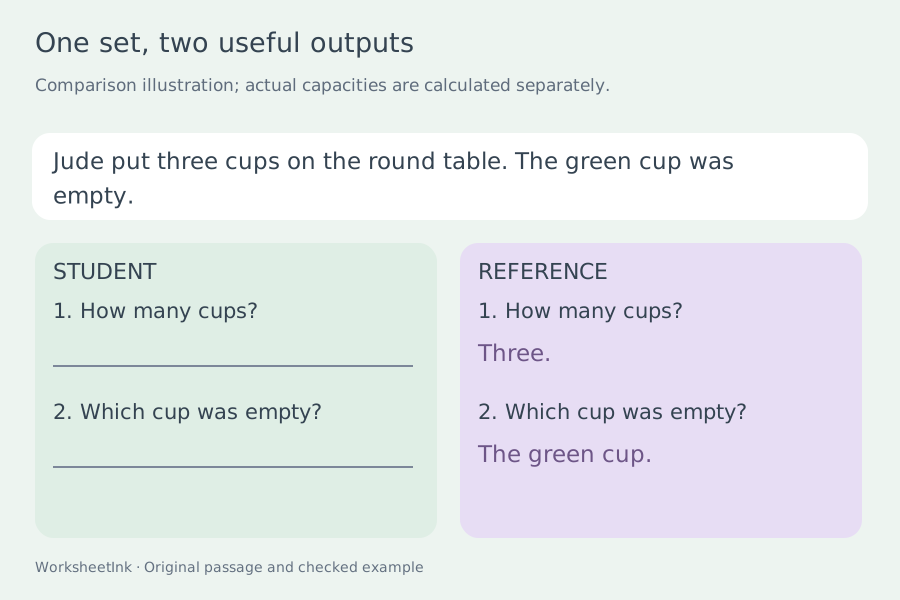
The student grid and teacher grid are estimated independently. Longer references, quotations and marking notes therefore do not automatically loosen the student layout. Capacity summaries report both outputs. The calculation is conservative and can reduce the actual rows or columns; it does not make the requested grid fit by shrinking text. Leave additional space when learners need to quote a phrase and explain its relevance.
- 06
Choose where the text belongs and keep the whole version
Request the passage on each question page for a short close-reading activity, or use a separate reading page when learners should keep the text beside the questions. If an output cannot fit a repeated passage and a usable question row, it automatically uses a separate reading page and reports that choice.
Student and reference outputs can consequently have different page counts or passage placement. Match their version identifiers when saving them separately. Choose A4 or Letter in both the page controls and browser dialog, then inspect all pages. Download JSON for the exact passage, pool, selection, evidence and edits. Local browser saving is convenient but can be cleared; it is not a cloud classroom record.
Questions before you print
Practical details about source content, answers and paper.
You supply the passage and the questions, or load the original practice example. The maker selects and formats that checked material and validates that each quoted excerpt occurs in the passage. It does not infer a reading level, write new questions from a topic or automatically establish that an answer is supported. This keeps the content and marking decisions under the teacher's control.
Use single-answer multiple choice, short response and open response in the same set. Choices need two to six different options and one correct letter. Every item requires a reference and an exact source excerpt. Open responses additionally require scoring guidance. Other reasonable short responses or interpretations may be accepted by the teacher; the website does not automatically compare student wording with the reference.
The excerpt must contain at least three non-space characters and occur in the passage after Unicode normalization and whitespace folding. This lets a quote span a line or paragraph break without failing solely because of spacing. Matching is case-sensitive. The check proves that the supplied words occur, not that they logically answer the question. Read the full context and review each connection yourself.
Give one acceptable reference response, a relevant excerpt and scoring guidance that explains what to look for. State how a learner should connect an interpretation to the text, rather than demanding a single memorized sentence. The teacher copy preserves these fields separately. It does not parse point allocations, evaluate an inference, decide partial credit or collect students' written responses.
Yes. Choose a separate reading page, or request the passage on each question page. Each output estimates its own capacity. If a repeated passage would leave too little question space, that output uses a separate reading page and reports the change. The teacher copy can therefore have a different layout and page count from the student copy. Every page retains the same content version.
Request one to six columns, one to twelve rows and compact, normal or extra space. A short prompt needs less width than choices or a full evidence reference. The student and teacher grids are calculated separately so longer marking notes do not automatically spread out the student paper. Read both capacity summaries and inspect the actual A4 or Letter print preview before making copies.
Malformed entries and excerpts not found in the passage are reported as invalid input positions. Exact repeats are removed. The same prompt with conflicting information is omitted in both places until you resolve it. If fewer valid questions remain than requested, the actual count is shown. Shorten material that cannot fit the available page space instead of expecting the tool to cut off the text.
Yes. Download JSON to keep the source text, title, input pool, selected questions, excerpts, marking notes, edits and layout. Import validates the derived worksheet before restoring it. Changing the passage requires generation so its evidence relationships can be checked again. Layout changes preserve the content version, while a question edit creates a revision. Browser saving is local to the device and may be cleared.
Prepare the next useful practice sheet
Review the task and give learners room to explain.
Browser printing & PDF · No registration