NOTICE · ELIMINATE · EXPLAIN
Sudoku generator A small grid, a reason for every digit
Make printable sudoku in 4×4, 6×6 or 9×9 grids with independently checked unique solutions. Choose cell-single practice or a category that also needs hidden singles, then arrange the puzzles on paper. This sudoku generator keeps each student grid paired with its solution, clue count and a first-step reference, so a short practice session can focus on explaining a placement rather than guessing.
Unique solutions · Adjustable density · Local saving
Sudoku generator
Choose the puzzle rules, generate and review both outputs.
My worksheets
Drafts save automatically in this browser, including unfinished input. Keep up to 20 named worksheets across all tools. Large images may exceed browser storage; download data as a backup.
Worksheet preview
Fit complete rows onto each page using the selected columns and writing space. Extra page space stays at the bottom; answer gaps are not stretched.
Request 1–6 puzzles across and 1–12 rows. Readability can reduce the actual grid.
Generate a set to review puzzles and matching solutions.
Match A4 or Letter in the browser print dialog. Choose Save as PDF and review every student and answer page; switch off browser headers and footers if needed.
Choose the reasoning before the paper density
Grid size changes the workspace; technique changes the practice.
A rule learners can check in three directions
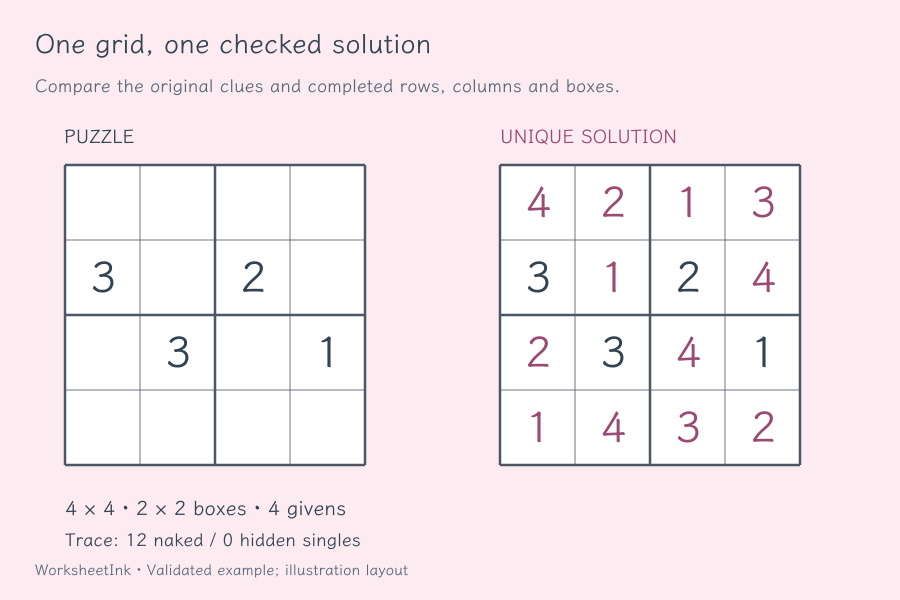
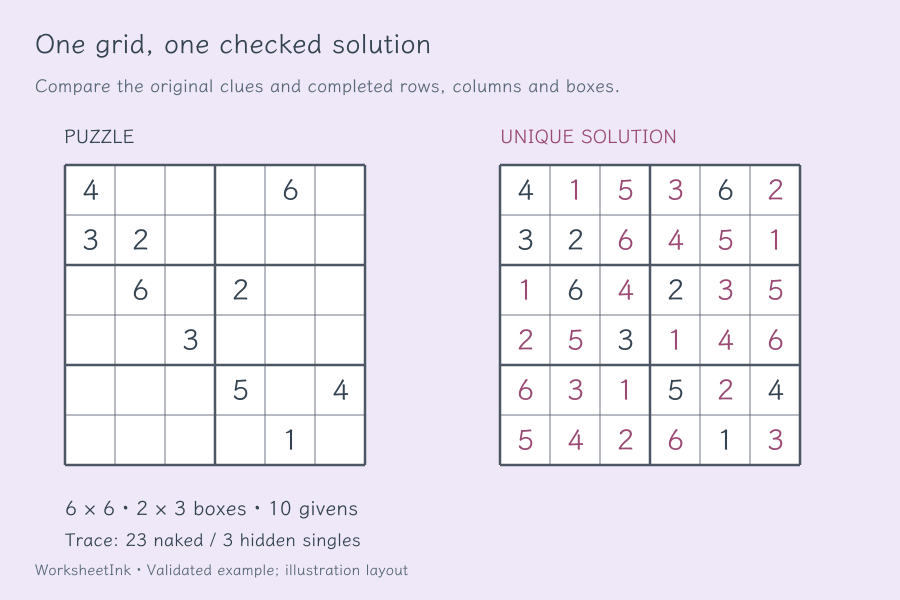
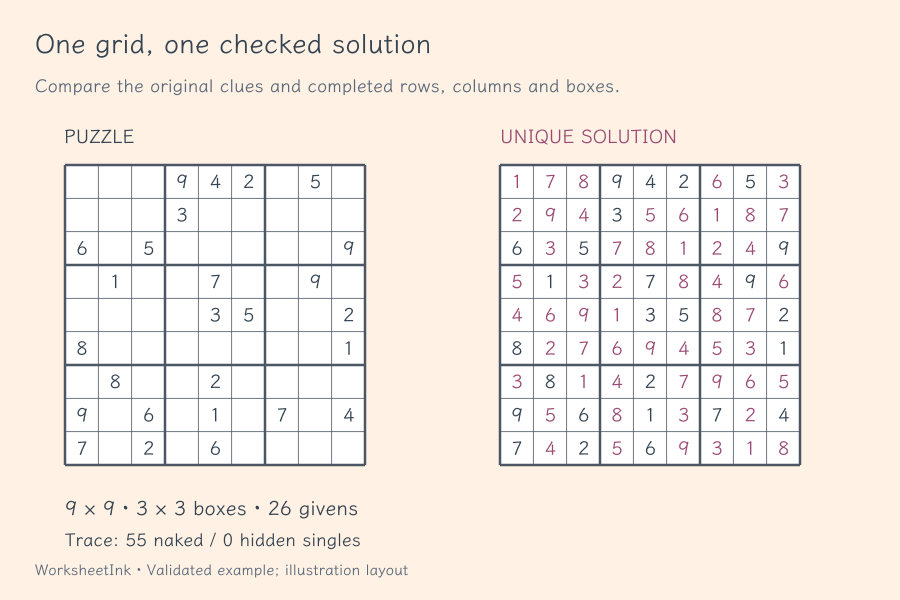
Fill every empty cell with a digit from one to the grid size. Each row, column and outlined box must contain each digit once. The 4x4 sudoku option uses 2×2 boxes; 6x6 sudoku uses boxes two rows high and three columns wide; the standard nine-cell rows use 3×3 boxes. The thicker boundaries make those groups visible. Choose a smaller grid when the class needs time to practise checking the same placement against all three groups. Digits are symbols here: no addition, multiplication or arithmetic calculation is required.
Sudoku with answers that belong to the exact clues
The teacher output contains the complete solution, number of givens and counts from the supported logical solving trace. A separate search checks for exactly one solution before a puzzle is accepted. The two practice categories describe the techniques used by this solver, rather than a universal easy or hard rating. Fewer clues alone do not establish a harder puzzle. Student pages keep the missing digits empty. An optional first-step hint reveals one forced placement and its technique; leave it off when learners should find their own starting point.
Build a focused set without crowding the cells
Keep the reasoning, grid size and room for handwriting in balance.
- 01
Start with the rule and box shape
Select four, six or nine cells per side. Tell learners which digits are available, then point to a row, a column and one thick-bordered box. A six-by-six grid is not made from square boxes: the two-by-three grouping matters when checking a candidate.
Use a short demonstration before distributing a large batch. Ask why a digit cannot appear in a particular blank, and name the group that excludes it. A correct placement without a reason can be a lucky guess. These pages provide paper puzzles and references; they do not watch a student solve or assess reasoning automatically.
- 02
Choose an explicit singles category
Cell-single practice completes with naked singles: a blank has exactly one candidate after checking its peers. Hidden-single practice first uses available naked singles, then requires at least one placement whose digit has only one possible location in a row, column or box. This version offers that second category for six- and nine-cell grids.
The classification follows a fixed solving order and is not a promise about how every human will experience the puzzle. Both categories finish using only these two techniques, without guessing, pairs or advanced chains. Four-cell grids offer the first category here. Clue counts are reported as useful context, not used as the sole difficulty label.
- 03
Generate a manageable batch and review the result
Request one to 24 puzzles and use a version seed to reproduce a set with the same rules. Generation removes clues from valid complete grids, keeps boards solvable by the chosen techniques and checks accepted boards with a separate bounded solution search. Exact duplicate clue boards are omitted within the set.
The generator tries a finite number of candidates. If it cannot meet the requested number, the actual count and a warning are shown; it does not fill remaining slots with unverified puzzles. This construction varies digits and permitted row and column groupings. It is not a uniform sample of every possible Sudoku or a claim that each board has a minimum clue count.
- 04
Edit a grid while keeping the same practice goal
Open an item editor and enter the complete grid with one digit per cell. Use zero or a dot for each blank; spaces and line breaks may help you read rows. The number of cells must match the selected size. Repeated givens, invalid symbols and a fully filled or entirely blank board are rejected.
The replacement must also pass the selected technique category and the independent uniqueness check. An advanced puzzle can be valid Sudoku yet fall outside these teaching categories, so this editor is not a universal Sudoku importer. An accepted change creates a content revision and rebuilds that item’s solution and trace; the other questions remain paired with their original answers.
- 05
Request one to six puzzles across, then read the actual capacity
Choose one to six items per row, one to twelve rows and zero, four or eight millimetres of extra space below each puzzle. The layout keeps a minimum cell size and reserves space for labels and hints. It reduces the actual number of columns or rows when your request would make the board too small.
A four-cell board can fit more densely than a nine-cell board. At the current conservative A4 widths, six small grids can fit across, while nine-by-nine boards may use at most three. Teacher notes and student hints can also change the row count. The capacity summary describes the estimated grid for each output; the row selector is a request, not an instruction to shrink handwriting cells indefinitely.
- 06
Keep the student pages and solutions together
Print the student output, the teacher output or both. Numbering and the content version connect corresponding puzzles even when the page counts differ. Teacher digits distinguish original givens with heavier type. A first-step reference uses row and column coordinates counted from the upper left, starting at one.
Save locally in the current browser for quick reuse, or download JSON containing the exact puzzles, solutions, traces and rules. Import rechecks the content before restoration. Browser storage may be cleared, so keep a downloaded copy for an important lesson. Select the intended A4 or Letter size in your print dialog and inspect the final preview before copying a class set. Layout-only changes preserve the content identifier.
Before you print
Practical answers about rules, solutions and paper.
Each accepted grid is checked by an independent backtracking search that looks for up to two solutions. A board is accepted only when the search finishes within its limit and finds exactly one, matching the logical solution. Finding one completed board alone would not establish uniqueness. Imported and manually edited puzzles pass the same validation before they can replace the current worksheet.
No. This tool groups puzzles by the supported solving trace: cell singles alone, or cell singles plus at least one hidden single. Clue count is displayed separately. A person may notice a different route through the same board, and these categories do not rank every Sudoku technique. Use the labels to choose a lesson focus rather than to promise an exact solving time.
Yes. Request one to six across and up to twelve rows, then check the actual student and teacher capacities. Grid size, a minimum five-millimetre cell target, references and added space can reduce the request. A 9×9 board will not be compressed into six narrow columns. Review your browser’s paper size and preview before printing several copies.
Use digits one through six. Each row, each column and each box must contain all six once. In this maker a box is two rows high and three columns wide. The thick grid lines show those boundaries. Do not apply the three-by-three boxes of a standard nine-by-nine puzzle to the smaller board.
It shows one forced row-and-column placement from the stored trace and names naked single or hidden single. The hint is optional on the student sheet; the teacher reference always includes it. It is a starting aid, not a complete annotated solution or a guarantee that a learner will choose the same first move. Turn it off for independent practice.
Yes, through an individual item’s editor after generating a set. Enter the selected number of cells with zero or dots for blanks. The board must have a unique solution and fit the current technique category. A conflict-free board that needs more advanced methods is rejected by this focused practice editor. Change the category or use a suitable singles puzzle.
Changing columns, requested rows, extra space or the hint switch keeps the same puzzle content identifier. Editing a grid creates a revision; generating again can replace the whole set. Download the worksheet data when you need the exact clues and matching references later, rather than relying only on a remembered title or a screenshot.
This is a printable worksheet maker. It does not record student entries, time attempts, diagnose each mistake or award scores. Students write in the blank cells on paper, and you use the corresponding solution for checking. For a teaching discussion, ask learners to identify the row, column or box that justifies a placement before showing the reference.
Prepare a fresh set for the next session
Choose the rules, check the result and keep the matching answer copy.
Browser printing & PDF · No registration