MEASURE THE SAME THING
Unit conversion worksheet generator change the unit, keep the quantity
Use this unit conversion worksheet generator for length, mass, capacity, area and volume practice. Choose metric or US customary measurements, set the input precision and answer policy, then request one to six problems per row. Review the actual questions and matching answers before printing.
Custom practice · 1–6 requested columns · A4 / Letter
Set up conversion practice
Set the content and paper layout independently.
My worksheets
Drafts save automatically in this browser, including unfinished input. Keep up to 20 named worksheets across all tools. Large images may exceed browser storage; download data as a backup.
Worksheet preview
Fit complete rows onto each page using the selected columns and writing space. Extra page space stays at the bottom; answer gaps are not stretched.
Requested columns, grid rows and space are independent. Actual capacity follows the content without replacing it.
Generate to review the content and matching reference.
Match A4 or Letter in the browser print dialog. Choose Save as PDF and review every student and answer page; switch off browser headers and footers if needed.
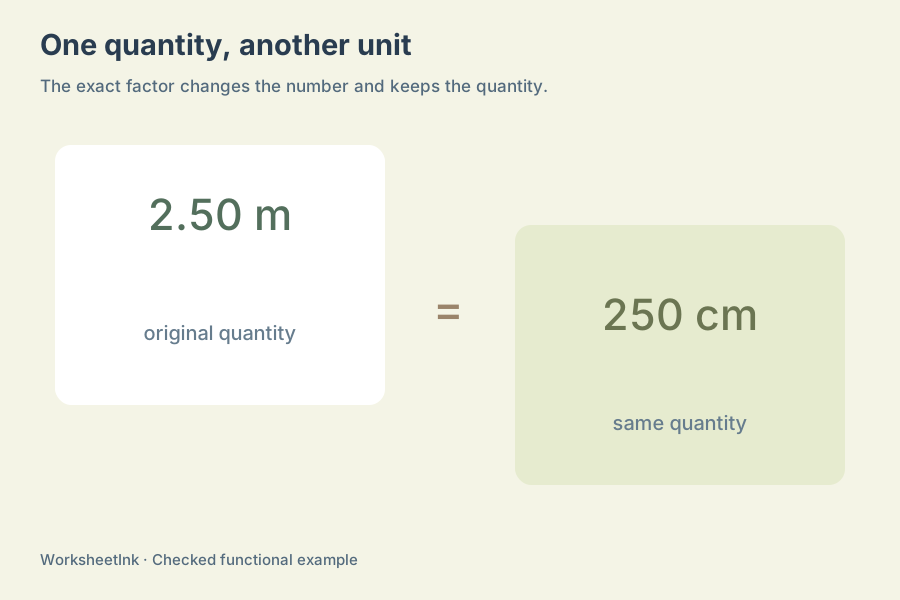
A conversion changes the number, not the amount
Keep dimensions, systems and output units visible.
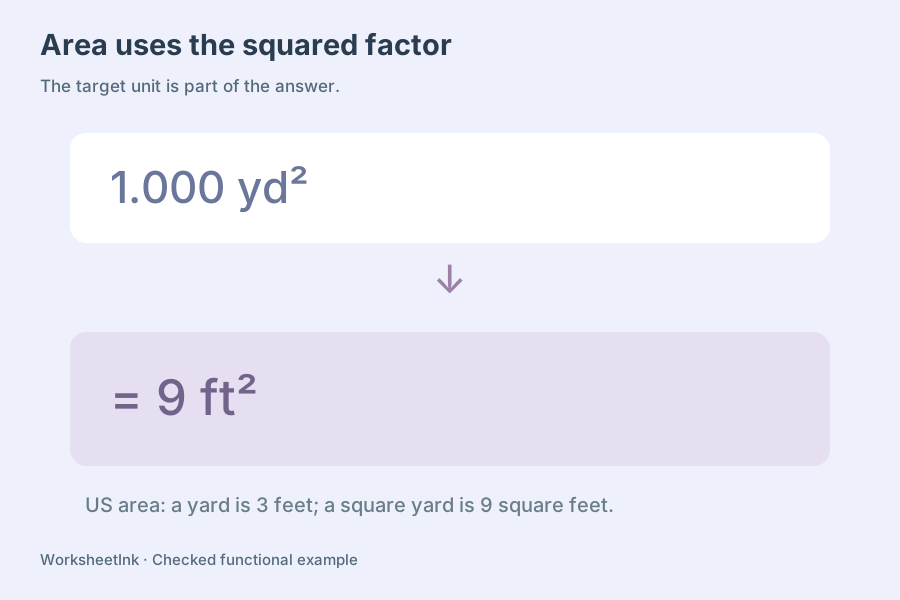
Square and cubic units need their own factors
A metre contains one hundred centimetres, but a square metre contains ten thousand square centimetres. A cubic metre contains one million cubic centimetres. The generator keeps length, area and volume in separate families, so a length factor cannot accidentally be applied to a square or cube. In metric volume practice, cubic centimetres can also be compared with millilitres, and cubic decimetres with litres. These are volume relationships; converting a volume to a mass would require additional information and is not offered.
The measurement system is part of the question
Choose metric units or a separate US customary set. Within the US set, capacity means US liquid measure, mass uses avoirdupois ounces and pounds, and the ton is explicitly a US short ton. A fluid ounce is a volume unit, not an ounce of mass. The tool does not silently mix US and British Imperial gallons, and it does not generate cross-system conversions. The selected system is printed with the worksheet instructions so the answer key is interpreted consistently.
Prepare measurement worksheets with a specific purpose
Choose the family, direction, numerical range and paper layout separately.
- 01
Start with the unit family learners need
Select length, mass, capacity, area or volume. Several selected families create mixed practice with separate single-step questions. Metric conversion worksheets can include millimetres through kilometres, milligrams through tonnes, common litre prefixes, square units and cubic units. The US collection has its own length, mass, liquid-capacity, area and cubic-volume choices.
Focus on one family when introducing a factor, then mix families once the distinction is secure. An area prompt and a length prompt may use similar-looking unit names but test different relationships. Request one to 200 questions, with at least as many requested questions as selected families. The preview reports the number actually generated and the counts by family.
- 02
Control the units and the conversion direction
Leave source and target as any eligible unit for variety, or choose one or both to focus the sheet. For a fixed pair such as metres to centimetres, select the length family and choose those two units. Direction can be unrestricted, towards a smaller unit or towards a larger unit. Changing the system or selected families clears fixed unit filters so old choices do not leak into a new system.
Conversions between equal-sized but differently named volume units, such as millilitres and cubic centimetres, are allowed only in unrestricted direction. The smaller/larger filter refers to unit size, not to how many characters a symbol has. Identical source and target symbols are excluded. No pair can cross unrelated dimensions, even if a file is edited by hand.
- 03
Choose input precision without restricting the answer accidentally
Use an inclusive numerical range from zero to 1000 with zero to three input decimal places. Bounds must fit the selected grid; the tool will not round an out-of-grid bound silently. An input of 1.25 needs at least two places, while redundant trailing zeros do not change its value. The bounds describe the original number, not the converted result.
A smaller target unit can produce a much larger numerical answer, and a larger target unit can produce a small decimal. Exact mode keeps terminating results with up to fifteen decimal places, which accommodates small metric area and volume values. Integer-only answers filter by the exact converted quantity, rather than accepting a fractional result merely because rounding happens to make it look whole.
- 04
Decide whether approximation is part of the exercise
Exact mode excludes recurring decimal results. This matters for US customary units: one inch is one twelfth of a foot, so some input values do not have terminating decimal answers. Rounded mode permits these questions and keeps zero to six answer places with half-up rounding. Approximation marks distinguish changed values from exact answers.
The student prompt states the requested precision when rounded output is selected, and the answer includes its target unit. A value that is already exact at the requested precision keeps an equal sign. These are classroom decimal exercises rather than a significant-figures calculator or a professional measurement-uncertainty tool. No temperature offsets, mixed-unit quantities or dimensional formulas are implied.
- 05
Read shortage notices before distributing the sheet
Generation suppresses repeated prompts and cycles through available family pools. Small domains are enumerated completely; large domains use a bounded search. A shortage message distinguishes an exhausted finite pool from a search that stopped before finding enough questions. A selected family with no eligible unit pair or number is reported separately.
A fixed pair can make other selected families unavailable, and an integer-only restriction can remove many smaller-to-larger conversions. A zero-only range can also leave very few distinct questions. Broaden the range, relax the answer restriction or select fewer families when appropriate. Editing a replacement follows the same rules and refuses an exact duplicate.
- 06
Fit both the questions and their units on paper
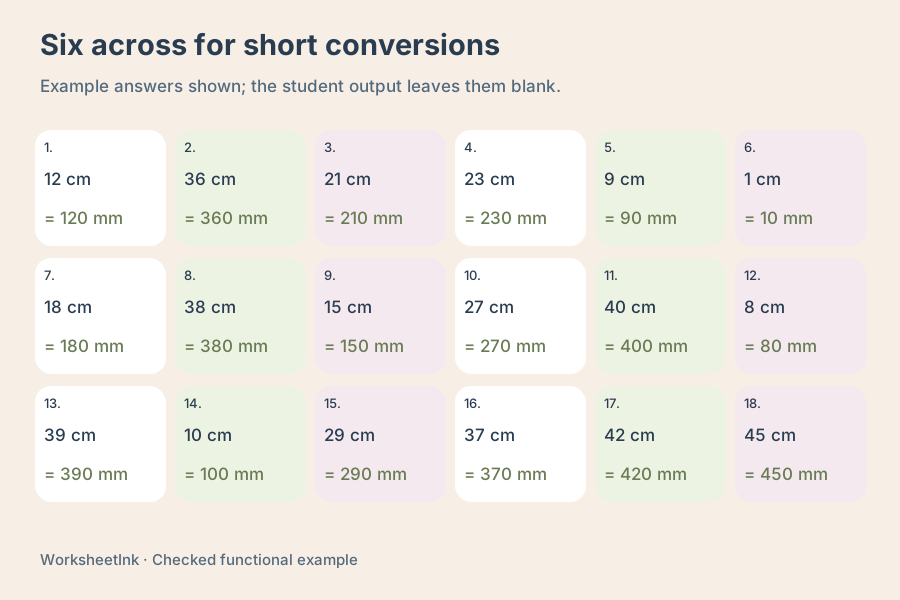
Request one to six columns, one to twelve rows and extra working space of zero, eight or sixteen millimetres. The layout checks the longest source or answer number and its unit. When a narrow arrangement cannot hold that content comfortably, actual columns are reduced and the change is reported. Effective rows also respect a conservative vertical question budget.
Short conversions can use dense layouts, while long square-unit results or rounded explanations may need fewer columns. Layout changes retain questions, edits and the content version. Browser-local saving preserves this set on the current device; downloadable JSON keeps exact questions for validated import. Print student and teacher copies from the same version on A4 or Letter, matching the browser paper setting.
Questions before making a class set
Know what the content, reference copy and layout settings do.
A smaller target unit requires more of those units to describe the same quantity, so the numerical value grows. A larger target unit requires fewer. For example, 2 m equals 200 cm, while 200 cm equals 2 m. Use the actual factor between the chosen units; metric prefixes do not all represent a single step of ten.
The length scale is applied in two dimensions for area and three for volume. Since 1 m equals 100 cm, 1 m² equals 100 × 100 cm² and 1 m³ equals 100 × 100 × 100 cm³. The generator stores these families separately and uses their own factors in both directions.
Yes, in metric volume practice. One millilitre equals one cubic centimetre, and one litre equals one cubic decimetre. Equal-sized unit names need unrestricted direction; they do not count as larger or smaller units. Capacity-only practice keeps litre-family units together, while the volume family supplies the cubic-unit relationships.
The customary option uses US liquid gallons, cups, pints, quarts and fluid ounces. Mass ounces are avoirdupois ounces and belong to the mass family. British Imperial liquid units are not included. The tool also keeps metric and US customary practice separate, so it never asks an ambiguously labeled gallon-to-litre conversion.
Some conversions give recurring decimals, and exact mode excludes those. Integer-only output further requires the unrounded result to be whole. Tight numerical bounds or fixed unit filters can leave few eligible prompts. The actual count and notice explain the result; rounded mode or a wider range can provide a different useful exercise.
Yes, six columns are available as a requested density. Long numbers or unit names can reduce actual columns to preserve readable content. Requested rows and working space are separate controls, and the effective capacity is shown. Short prompts fit more densely than long area or volume conversions; try one real sheet before printing a class stack.
No. Columns, requested rows and extra space rearrange the current set and its matching key. Editing a question does change its revision and recalculates the answer, while regeneration replaces the set after the existing confirmation flow when necessary. Keep a downloaded data copy if you need those exact conversions later.
Save locally to reopen on this device, or download JSON for validated import of the exact questions. For a PDF, use the browser print dialog and select student, teacher or both copies. Every answer includes its target unit. There is no cloud backup, learner scoring or automatic interpretation of a pasted textbook exercise.
Make the next practice sheet useful
Review the content, then leave the space your learners need to write.
Browser print / Save PDF · No registration