READ THE SCALE · FOLLOW THE JUMPS
Number line worksheet generator Make every interval mean something
Build a short set that connects numbers, positions and movement. This number line worksheet generator creates missing-label practice and addition or subtraction jumps with matching explanations. Choose an integer or unit-fraction scale, include negative positions when useful and arrange the page around the space learners need to read, count and write.
Equal intervals · Clear answer spaces · Explained answers
Number line worksheet generator
Make the tick spacing explicit, then practise missing labels or one-interval jumps.
My worksheets
Drafts save automatically in this browser, including unfinished input. Keep up to 20 named worksheets across all tools. Large images may exceed browser storage; download data as a backup.
Worksheet preview
Fit complete rows onto each page using the selected columns and writing space. Extra page space stays at the bottom; answer gaps are not stretched.
Request 1–6 questions across and 1–12 rows. Actual capacity protects readable markers, tick labels and writing space.
Generate a set to review the number lines and explained answers.
Match A4 or Letter in the browser print dialog. Choose Save as PDF and review every student and answer page; switch off browser headers and footers if needed.
Two ways to read the same mathematical picture
Practise the meaning of the scale before asking learners to follow a calculation.
Find the value behind a blank tick
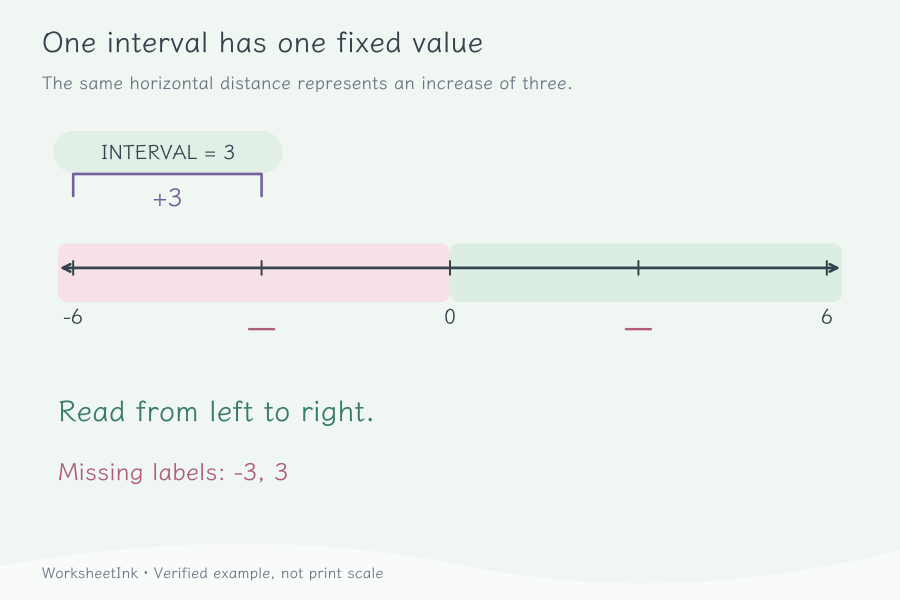
When learners find missing numbers on a number line, the space between marks matters as much as the numbers already shown. A step of two gives a different scale from a step of five, even when the drawings have the same number of marks. This mode keeps the endpoints visible and removes selected interior labels. Writing lines identify the places to complete, while the stated interval gives a reliable starting point. Ask learners to explain one missing value from a nearby known value, then check their reasoning across the line.
Connect a calculation with its direction
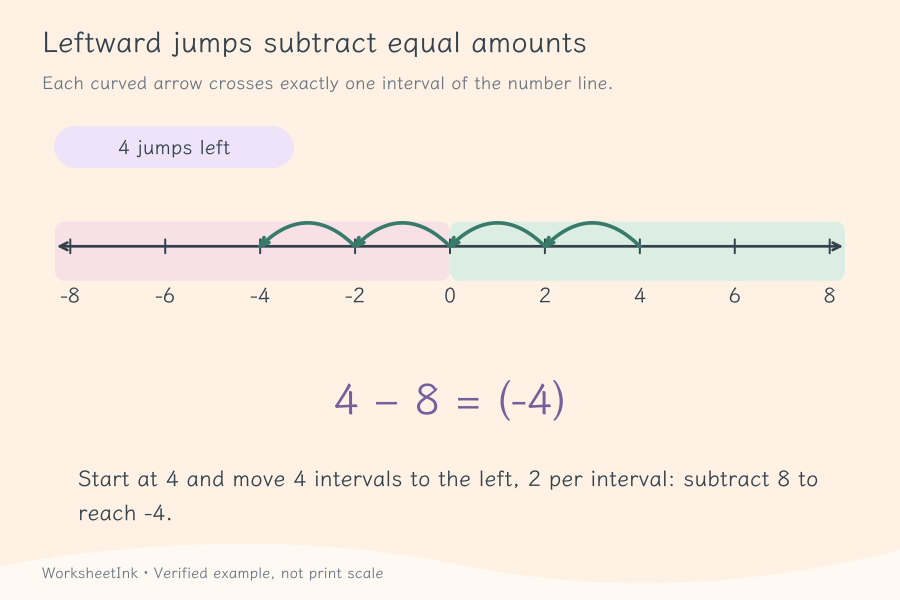
Number line addition and subtraction use a marked starting position and a series of equal hops. Each hop crosses one interval. The number being added or subtracted is positive and equals the hop count multiplied by the scale step. A starting position or result may still be negative. Students complete the equation; teacher pages show the result and describe the start, direction, number of intervals and distance moved. This supports a conversation about what the drawing represents, rather than checking only the final numeral.
Prepare a focused set of printable number line worksheets
Keep the scale, the task and the amount of support clear from the beginning.
- 01
Choose the skill for this set
Select missing labels, addition jumps or subtraction jumps. Each worksheet uses one mode so the instructions stay consistent. Missing-label practice asks learners to connect positions with values. Jump practice asks them to connect a movement with an equation. For a new topic, start with a short line and familiar numbers, then change one feature at a time. A change in scale, a negative starting position and a larger movement are different challenges; they do not all need to appear in the first activity.
The tool produces paper practice and a teacher reference. It does not collect student responses or grade them online.
- 02
Set the left endpoint and the interval size
In integer mode, Choose a left endpoint from −100 to 100, an integer step from 1 to 20 and four to twelve intervals. The right endpoint is calculated from those choices: left endpoint plus step multiplied by interval count. It can therefore be greater than 100. There is one more tick than there are intervals. All questions in the set share this scale.
For example, a left endpoint of −8 with eight intervals of two ends at 8. The nearby labels are −8, −6 and −4, rather than consecutive integers. A learner should count the gaps between marks and connect each gap with its stated value; counting marks alone can introduce an extra step.
- 03
Choose how many interior labels to hide
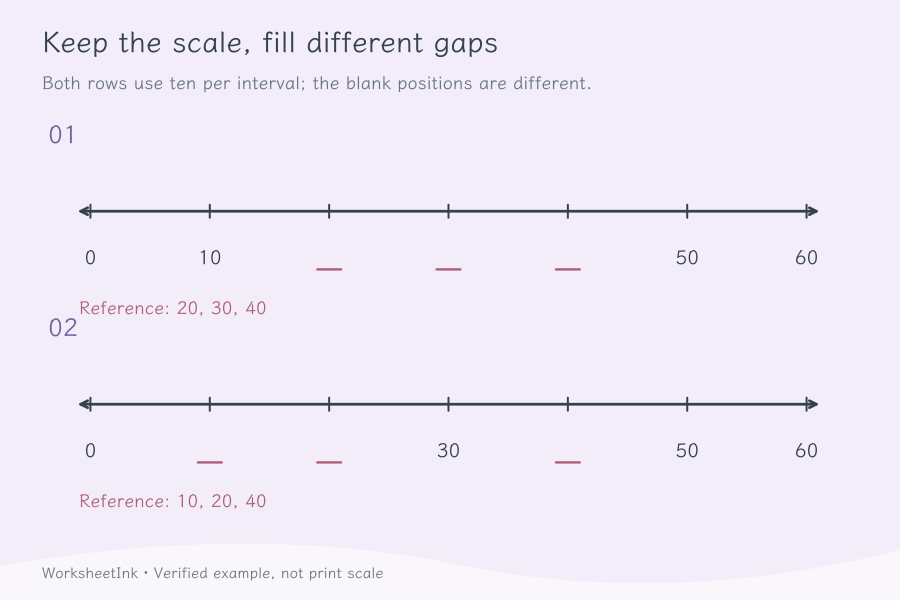
In missing-label mode, request one to four interior blanks, within the available interior positions. Both endpoints remain given. A blank has a writing line beneath its tick. Encourage learners to use a known neighbour, the left endpoint or a combination of forward and backward counting, then compare whether these methods give the same value.
Request one to 24 questions. The available distinct blank combinations are finite, so a narrow configuration can produce fewer items. The actual count is shown rather than filled out with copies. If you need more variety, change the number of intervals or the number of missing labels and generate a new set.
- 04
Match each hop to the amount in the equation
For addition or subtraction, set a maximum of one to six hops. Each generated movement stays inside the chosen endpoints and uses no more than that maximum. Addition moves right because the added amount is positive; subtraction moves left because the subtracted amount is positive. A negative starting position does not reverse either rule. Starting at −6 and adding 4 on a scale of two takes two hops to −2.
The student diagram gives the endpoints, starting label and movement with an incomplete equation. The answer page completes the values and explanation. Integer and fraction modes both add or subtract positive amounts; negative second operands, decimal steps, inequalities and double number lines are not supported.
- 05
Balance page density with readable tick spacing
Choose one to six questions across, one to twelve problem rows in manual mode and zero, four or eight millimetres of additional working space. The planner checks the interval spacing and the width needed for numeral labels before accepting the actual columns. A twelve-interval line with negative or longer values needs more room than a short line with single-digit labels. Selecting six across is a request; it is not a promise that every scale will fit six readable diagrams.
Read the actual grid and the separate student and teacher page counts. The answer copy may need more space for explanations. Match A4 or Letter in the print dialog and check the preview before making copies.
- 06
Review, replace and keep the exact activity
Check a few questions against the scale and compare their item numbers with the teacher reference. You can replace an individual question by changing its replacement seed; the replacement stays within the current settings and cannot duplicate another item in the set. It is a generated replacement, not an editor for typing an arbitrary equation. After an edit, use the new revision with its matching answer copy. Changing only page density or extra space preserves the mathematical content.
Save in this browser for a quick return, or download the worksheet data to retain the exact set beyond the current browser session. Import validates the saved questions and answers. Browser storage can be cleared, so keep a downloaded copy for lessons you intend to repeat.
- 07
Keep the whole clear when switching to fractions
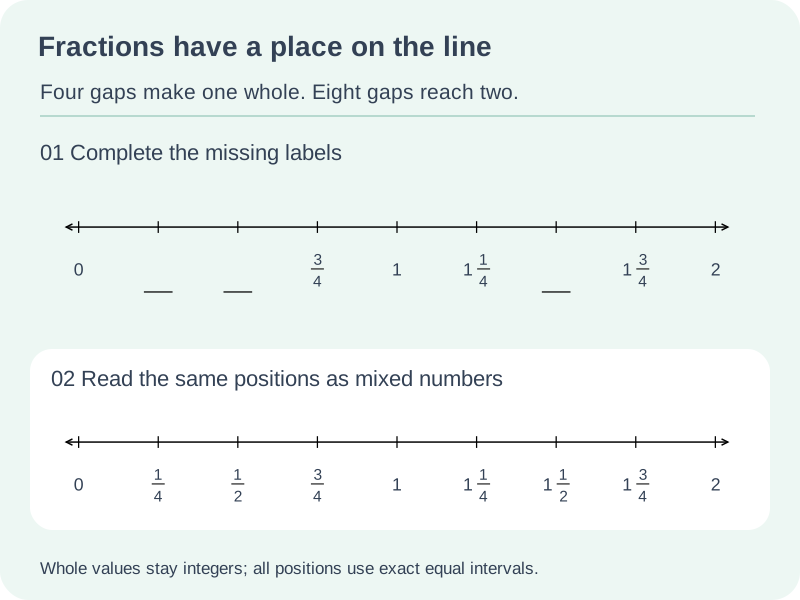
Select Fractions and choose how many equal intervals make one whole. With fourths, six intervals from zero reach 6/4, the same position as 1 1/2. The interval count describes the whole displayed line, while the denominator describes just one unit. An eight-interval line in fourths runs from zero to two; eight is not the denominator. Start by identifying zero, one and the unit length before reading an interior label.
The answer-format choice changes how the same positions are named. Keep partitions to show 2/4 as 2/4, simplify to show 1/2, or use mixed numbers to write 6/4 as 1 1/2. Exact whole values appear as integers in every format. A negative mixed label such as −1 1/2 means the entire value is negative: it is −3/2, not negative one plus a half. The stacked numerator and denominator leave the sign outside the fraction.
Fraction jumps each cross one unit-fraction interval. Three jumps on a fifths line represent 3/5, regardless of where the movement starts. Addition moves right and subtraction left; either may cross zero when the axis includes it. Compare the equation and the arrow direction before giving out the sheet. If an existing integer left endpoint is outside −3 to 3 when you switch modes, adjust the setting after the visible error rather than assuming the old range was silently changed.
To connect representations, first prepare a shaded-shape activity in the fraction tool, then prepare number-line practice with the same denominator. Download each data file and add it to the quiz maker’s mixed activity packet. The two sets keep their own questions; adding them does not automatically pair equal values across sections. Give a short explanation question if you want learners to compare a particular shaded amount with a particular position.
Questions about scales, jumps and printing
Small distinctions that make the worksheet easier to teach and check.
Read the interval value first. Move from a known label by that value for each gap, keeping the same scale throughout. The endpoints and any remaining labels provide checks. On a step of five, two intervals represent a change of ten. A writing line under a tick marks a label to complete; it does not change the spacing.
Yes. A negative left endpoint can create a line below zero or one that crosses zero. Jump questions may start or finish at a negative value. The added or subtracted amount is always a positive multiple of the chosen step. Use the displayed endpoints to check that the scale covers the part of the number system you want.
Yes, because these questions subtract a positive amount. Addition questions add a positive amount and move right. In mathematics more broadly, subtracting a negative number moves right; that case is not generated here. Keep the sign of the starting number separate from the operation and the sign of the second operand when explaining direction.
Yes for fractions: choose Fraction mode and divide each whole into 2, 3, 4, 5, 6, 8, 10 or 12 equal intervals. Start at an integer from −3 to 3 and use four to twelve intervals. Missing labels and both jump modes are available, with partition, simplified or mixed-number answers. Decimal intervals are not supported.
An interval is the gap between adjacent ticks and has the value set by the step. Each drawn hop crosses one interval. Three hops on a step of two therefore represent six units of movement. The teacher explanation includes both the hop count and the amount, helping learners connect the visual action with the equation.
Only distinct questions within the selected settings are included. Missing-label sets are limited by the available interior positions; jump sets are limited by legal starts, directions and lengths inside the range. If the pool is smaller than your request, the worksheet reports the actual total. Expand the settings when you need additional variety.
Yes, request one to six across and then check the actual capacity. Tick spacing and numeral width can require fewer columns, while row spacing and teacher explanations affect how many rows fit. Keeping a line legible is more useful than squeezing its labels together. The output summary reports student and teacher pages separately.
Yes. Use the item editor to generate a replacement within the current rules, then save or download the revised worksheet data. Duplicate items are rejected. The reference is rebuilt with the replacement, and the revision identifies the updated content. Keep that reference with its student pages instead of mixing it with an older printout.
No. Count equal gaps within one whole unit. A line from zero to two with eight gaps uses fourths because each unit has four gaps. There is one more tick than gap. A displayed line may end at a fraction; that does not change the denominator or the unit size.
Numerators, denominators, minus signs and whole-number parts need enough horizontal space. The planner keeps stacked labels readable and reduces the effective column count when needed. Check the reported density before printing. Automatic pagination still fills the available height with complete rows; manual mode retains your requested row limit.
Give the next calculation a place to start
Choose the scale, make a focused set and keep the explanation beside the answer.
Browser printing & PDF · No registration